What is process optimization?
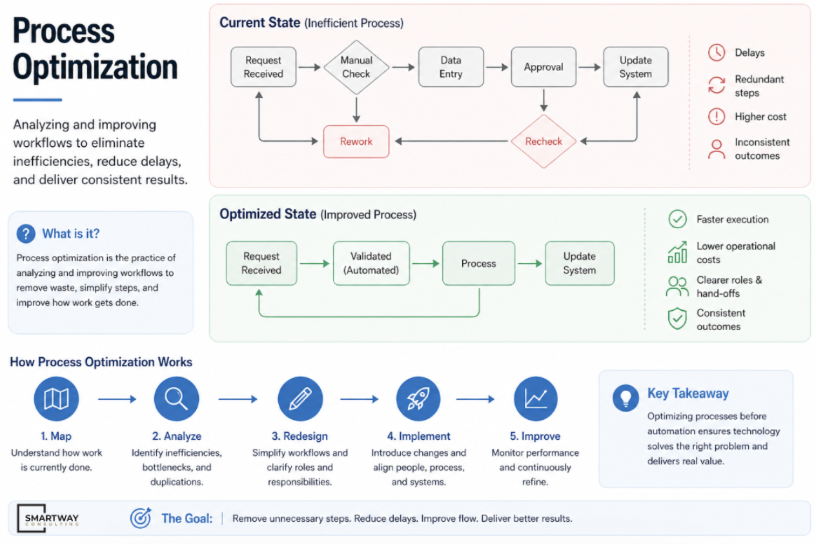
Process optimization is the practice of analyzing and improving workflows to eliminate inefficiencies, reduce delays, and increase consistency in how work gets done.
It focuses on how tasks move between people, systems, and steps and aims to make execution faster, clearer, and more reliable.
Process optimization is often supported by established methodologies such as Lean, Lean Six Sigma, and Business Process Management, as these frameworks not only offer structured approaches to analyzing workflows, but also provide systematic ways to identify inefficiencies and implement improvements; consequently, they enable organizations to enhance performance in a more consistent and measurable manner.
Why process optimization matters
As organizations grow, processes become more complex.
Workarounds appear, responsibilities become unclear, and tasks take longer than expected.
This leads to:
- Slower execution
- Miscommunication between teams
- Inconsistent results
- Increased operational costs
- Over-reliance on key individuals
Process optimization helps organizations simplify how work is done and improve overall performance.
Many organizations apply principles from Lean to eliminate waste, or from Lean Six Sigma to reduce variation and improve quality.
Common signs your processes need improvement
Many organizations don’t realize their processes are inefficient until problems become visible.
Typical signs include:
- Tasks take longer than expected
- Work is duplicated or repeated
- Teams are unclear about responsibilities
- Results vary depending on who performs the task
- Bottlenecks slow down delivery
These issues usually point to underlying process problems, not individual performance.
How process optimization works
Process optimization follows a structured approach, often aligned with frameworks like Business Process Management.
Step 1: Map current workflows
Understand how work is actually being done, step by step.
Processes are often documented using standards such as BPMN 2.0, which provide a clear visual representation of workflows.
Step 2: Identify inefficiencies
Find delays, bottlenecks, duplications, and unnecessary steps.
Step 3: Redesign processes
Simplify workflows and clarify responsibilities.
Step 4: Implement changes
Introduce the improved process within the team or organization.
Step 5: Monitor and refine
Track performance and continuously improve over time.
Process optimization vs automation
Process optimization and automation are closely related but not the same.
Process optimization improves how work is done.
Automation uses technology to execute tasks faster.
Automating a poorly designed process often leads to faster inefficiencies.
Optimizing processes first, often using principles from Lean or Lean Six Sigma, ensures that automation delivers real value.
What results can you expect?
Effective process optimization leads to measurable improvements:
- Faster execution of tasks
- Reduced operational inefficiencies
- Clearer roles and responsibilities
- More consistent outcomes
- Lower dependency on manual work
Organizations that combine process optimization with structured approaches like Business Process Management often achieve more sustainable results over time.
When should you optimize your processes?
Process optimization is especially important when:
- Your organization is growing
- Work is becoming harder to manage
- Delays and bottlenecks are increasing
- You are preparing to automate workflows
- Teams are struggling with coordination
These are clear signals that existing processes need to be improved.
Frequently asked questions
Q. What is process optimization in simple terms?
It is the process of improving workflows so work can be done faster, with fewer errors and less confusion.
Q. How is process optimization related to Lean and Six Sigma?
Lean focuses on eliminating waste, while Lean Six Sigma combines waste reduction with reducing variation and improving quality. Both support process optimization.
Q. What is BPM in process optimization?
Business Process Management is a structured approach to managing and improving processes across an organization, often supported by tools, governance, and continuous monitoring.
Q. What is BPMN 2.0 and why is it used?
BPMN 2.0 is a standardized way to visually map processes, making workflows easier to understand, analyze, and improve.
Q. Is process optimization only for large companies?
No. Any organization with structured workflows can benefit from improving how work is done.
Q. How long does process optimization take?
It depends on the complexity of the processes, but many improvements can be identified and implemented within a few weeks.
Q. What is the first step in process optimization?
The first step is to map how work is currently being done, including all steps, roles, and handoffs.
Final thought
Processes are the foundation of how work gets done.
When they are unclear or inefficient, performance suffers, regardless of how capable the team is.
Organizations that actively optimize their processes using structured approaches like Business Process Management and methodologies such as Lean Six Sigma are able to move faster, reduce friction, and scale more effectively.