
In a world full of chaos, complicated workflows, and “Who was supposed to do that?” moments, BPMN 2.0 is the universal language that helps everyone finally understand how work should flow. Whether you’re leading a team, optimizing operations, or just trying to make daily tasks less messy, mastering BPMN 2.0 gives you clarity, consistency, and control.
What is BPMN 2.0 (and why should you care)?
BPMN 2.0, or Business Process Model and Notation, is the globally accepted method for visually mapping business processes. Think of it as a clear, standardized way of drawing how work flows from start to finish, so that anyone (yes, even the non-technical ones) can understand what’s happening.
It removes ambiguity.
It eliminates guessing.
And it turns complicated processes into simple, visual stories.
BPMN is like giving directions to a friend
Imagine this:
You’re giving your friend directions to your house.
Option A:
You send a long text full of steps, turns, landmarks, and “oh, and don’t miss the part where the road splits.”
Option B:
You send a simple map (Share Location)
Which one helps them get there faster and without calling you five times?
Exactly.
BPMN 2.0 is the map. Traditional explanations are the long text messages.
When teams don’t use BPMN, instructions get misunderstood, extra steps appear out of nowhere, and responsibilities get lost. But with BPMN 2.0, everyone sees the same map, follows the same path, and reaches the same destination.
Why BPMN 2.0 matters for modern organizations
- It brings clarity to chaos
Processes often exist in people’s heads. BPMN brings them to life on paper: visually, cleanly, and accurately.
- It aligns teams and eliminates miscommunication
When everyone understands the workflow, mistakes, duplicates, and bottlenecks disappear.
- It supports digital transformation
Automation platforms (Camunda, Signavio, Bizagi) speak BPMN natively.
If your organization wants to automate, BPMN isn’t just useful, it’s essential.
- It makes training faster
New employees learn faster when processes look like diagrams, not novels.
- It helps you spot inefficiencies instantly
A BPMN diagram highlights delays, handoffs, rework loops, and needless complexity in seconds.
The Core Elements of BPMN 2.0 (Explained Simply)
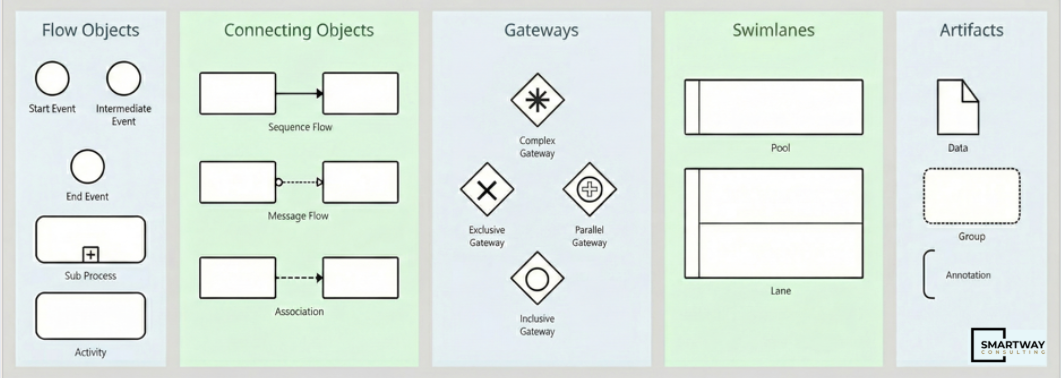
Events – The “stoplights” of the process
They show when something starts, changes, or ends.
Activities – The actual work being done
Everything from “Approve request” to “Prepare report.”
Gateways – The decision points
They split the process based on conditions or logic.
Flows – The arrows
They connect everything and show direction.
Once you understand these basics, you can model almost any business process with ease.
BPMN 2.0: The competitive advantage no one talks about
Companies obsess over strategy, KPIs, and new tools…
but miss one thing: If processes are unclear, nothing else works.
BPMN 2.0 gives you the structure your operations desperately need.
It’s the foundation for Lean Six Sigma, automation, digital transformation, and continuous improvement. https://www.process-lab.org/services/bpmn2-0/
Final Thought
BPMN 2.0 may look technical at first glance, but at its core, it’s just a smarter, clearer way to represent how work should happen. And once you start using it, you’ll never want to go back to mystery processes again.