
Why Lean Six Sigma still matters
Organizations today operate in an environment characterized by intense competition, rapidly changing technologies, increasing customer expectations, and constant pressure to reduce costs while maintaining high quality. In this context, companies must continuously improve their processes to remain competitive and sustainable.
One of the most powerful and widely adopted methodologies for achieving operational excellence is Lean Six Sigma.
Lean Six Sigma combines two complementary approaches to process improvement:
- Lean, which focuses on reducing waste and improving process flow.
- Six Sigma, which focuses on reducing variation and improving quality.
Together, these approaches provide organizations with a structured framework for improving processes, increasing efficiency, and delivering greater value to customers.
Originally developed in manufacturing environments, Lean Six Sigma has expanded into nearly every industry, including:
- Healthcare
- Banking and financial services
- Telecommunications
- IT and software development
- Logistics and supply chain management
- Government and public administration
Organizations that successfully implement Lean Six Sigma often achieve significant benefits, including:
- Lower operational costs
- Improved customer satisfaction
- Faster delivery times
- Reduced defects and errors
- Increased employee engagement
This guide provides a comprehensive overview of Lean Six Sigma, including its principles, methodology, tools, certification paths, real-world applications, and future trends.
What is Lean Six Sigma?
Lean Six Sigma is a data-driven methodology used to improve processes by eliminating waste, reducing variation, and increasing value delivered to customers.
At its core, Lean Six Sigma focuses on three key objectives:
- Improving process efficiency
- Reducing defects and errors
- Delivering greater value to customers
The methodology combines Lean’s focus on speed and efficiency with Six Sigma’s emphasis on precision and quality.
Organizations apply Lean Six Sigma to a wide variety of problems, such as:
- Reducing production defects
- Improving service delivery speed
- Reducing operational costs
- Improving customer satisfaction
- Optimizing supply chains
Lean Six Sigma projects typically follow a structured problem-solving framework known as DMAIC, which stands for:
- Define
- Measure
- Analyze
- Improve
- Control
This structured approach helps organizations solve complex problems systematically and sustainably.
The origins of Lean
Lean thinking originated from the Toyota Production System (TPS) developed in Japan after World War II.
Toyota engineers sought to create a production system that minimized waste while maximizing efficiency and quality. This system focused on continuous improvement and respect for people.
One of the key concepts in Lean is waste elimination.
Toyota identified seven major types of waste, known as the Eight Wastes of Lean:
- Overproduction
- Waiting
- Transportation
- Overprocessing
- Inventory
- Motion
- Defects
- Underutilized talent
By systematically identifying and reducing these wastes, organizations can significantly improve efficiency and reduce costs.
The origins of Six Sigma
Six Sigma was developed at Motorola in the 1980s as a methodology for improving product quality by reducing defects.
The term “Six Sigma” refers to a statistical concept that measures process variation. Achieving Six Sigma quality means producing only 3.4 defects per million opportunities.
Six Sigma gained widespread popularity in the 1990s when General Electric, under the leadership of Jack Welch, adopted the methodology and reported billions of dollars in savings.
Six Sigma emphasizes:
- Data-driven decision making
- Statistical analysis
- Structured problem solving
- Process control
By reducing variation in processes, organizations can deliver more consistent and reliable products and services.
Lean vs Six Sigma: Understanding the differences
Although Lean and Six Sigma share similar goals, they focus on different aspects of process improvement.
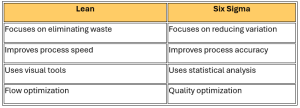
Lean Six Sigma integrates both approaches to create a balanced improvement methodology.
Why organizations use Lean Six Sigma
Organizations adopt Lean Six Sigma for several strategic reasons.
Cost Reduction
Lean Six Sigma helps organizations identify inefficiencies that drive unnecessary costs. By eliminating waste and reducing defects, companies can significantly lower operational expenses.
Improved Customer Satisfaction
By improving product quality and service reliability, Lean Six Sigma helps organizations deliver better customer experiences.
Faster Processes
Lean techniques improve workflow efficiency, enabling organizations to reduce delays and accelerate delivery times.
Data-Driven Decision Making
Lean Six Sigma promotes a culture where decisions are based on data rather than assumptions.
The DMAIC Methodology
The most widely used framework in Lean Six Sigma is the DMAIC methodology.
DMAIC provides a structured approach for improving existing processes.
Define Phase
The Define phase focuses on clearly understanding the problem and defining the goals of the improvement project.
Activities include:
- defining the problem statement
- identifying stakeholders
- understanding customer requirements
- creating a project charter
Tools commonly used include:
- SIPOC diagrams
- stakeholder analysis
- Voice of the Customer analysis
Measure Phase
The Measure phase focuses on understanding current process performance.
Teams collect data to establish a baseline and quantify the problem.
Common tools include:
- process mapping
- data collection plans
- capability analysis
Analyze Phase
The Analyze phase focuses on identifying the root causes of the problem.
Common tools include:
- root cause analysis
- fishbone diagrams
- Pareto analysis
- hypothesis testing
Improve Phase
The Improve phase focuses on developing and implementing solutions to address root causes.
Tools include:
- brainstorming
- pilot testing
- design of experiments
Control Phase
The Control phase ensures that improvements are sustained over time.
Common tools include:
- control charts
- standard operating procedures
- performance dashboards
Lean Six Sigma Tools
Lean Six Sigma practitioners use a wide range of tools to analyze processes and implement improvements.
Key tools include:
- SIPOC diagrams
- process mapping
- value stream mapping
- Pareto charts
- fishbone diagrams
- control charts
- root cause analysis
- hypothesis testing
- regression analysis
These tools help teams identify problems, analyze data, and implement effective solutions.
Lean Six Sigma Certification Levels
Lean Six Sigma certifications follow a belt structure similar to martial arts, representing increasing levels of expertise in process improvement. Each level reflects deeper knowledge of the methodology, stronger analytical skills, and greater responsibility for leading organizational improvement initiatives.
Yellow Belt
Yellow Belt is the entry-level certification in Lean Six Sigma.
It is designed for professionals who need to understand the fundamentals of process improvement but do not necessarily lead improvement projects themselves.
Yellow Belts are typically team members who participate in improvement initiatives led by Green Belts or Black Belts.
Green Belt
Green Belt certification represents the first professional level of Lean Six Sigma expertise.
Green Belts lead improvement projects within their departments while continuing to perform their regular roles.
They typically apply the DMAIC methodology to solve operational problems and improve process performance.
Black Belt
Black Belt certification represents an advanced level of expertise in Lean Six Sigma.
Black Belts typically work full-time on improvement initiatives and lead complex cross-functional projects.
They possess strong analytical skills and are capable of applying advanced statistical techniques.
Master Black Belt
Master Black Belt is the highest level of Lean Six Sigma expertise.
Master Black Belts focus less on individual projects and more on developing organizational improvement strategies.
They are responsible for building Lean Six Sigma capabilities across the organization.
Lean Six Sigma in different industries
Lean Six Sigma is used across many industries.
Manufacturing
Manufacturers use Lean Six Sigma to improve production efficiency and reduce defects.
Healthcare
Hospitals use Lean Six Sigma to reduce waiting times and improve patient care.
Banking
Financial institutions apply Lean Six Sigma to streamline service processes and reduce errors.
Service Industries
Service organizations use Lean Six Sigma to improve customer experience and operational efficiency.
How organizations implement Lean Six Sigma
Successful Lean Six Sigma implementation requires strong leadership support and structured governance.
Organizations typically establish roles such as:
- Executive Sponsors
- Champions
- Black Belts
- Green Belts
These roles help coordinate improvement initiatives across the organization.
Building a culture of Continuous Improvement
Lean Six Sigma is most effective when embedded into organizational culture.
A continuous improvement culture encourages employees to:
- identify improvement opportunities
- solve problems proactively
- participate in improvement initiatives
Organizations that foster such cultures often achieve sustained performance improvements.
Lean Six Sigma and Digital Transformation
Lean Six Sigma increasingly complements digital technologies such as:
- robotic process automation
- artificial intelligence
- process mining
Organizations often use Lean Six Sigma to optimize processes before automating them.
Lean Six Sigma and Sustainability
Lean Six Sigma also supports sustainability initiatives by reducing waste and improving resource efficiency.
Projects may focus on:
- reducing energy consumption
- minimizing material waste
- improving supply chain efficiency
Lean Six Sigma vs other methodologies
Lean Six Sigma vs Agile
Agile focuses on iterative development, while Lean Six Sigma focuses on process improvement.
Lean Six Sigma vs BPM
Business Process Management focuses on process design and governance, while Lean Six Sigma focuses on process optimization.
Lean Six Sigma vs Operational Excellence
Operational Excellence is a broader management philosophy that often includes Lean Six Sigma as a core component.
Lean Six Sigma in the age of Artificial Intelligence
Artificial intelligence enhances Lean Six Sigma by enabling organizations to analyze large datasets and identify patterns more efficiently.
AI technologies can help:
- predict process failures
- identify improvement opportunities
- automate repetitive tasks
Frequently Asked Questions about Lean Six Sigma
What is Lean Six Sigma?
Lean Six Sigma is a methodology used to improve processes by eliminating waste and reducing defects.
What is DMAIC?
DMAIC is a structured improvement framework consisting of Define, Measure, Analyze, Improve, and Control phases.
Is Lean Six Sigma certification worth it?
Yes. Lean Six Sigma certification can significantly enhance career opportunities by developing valuable problem-solving and analytical skills.
How long does Lean Six Sigma training take?
Typical durations include:
- Yellow Belt: 1–3 days
- Green Belt: 1–2 weeks
- Black Belt: 1–2 weeks
How to start your Lean Six Sigma journey
Professionals interested in Lean Six Sigma can begin by:
- learning the methodology
- completing training programs
- participating in improvement projects
Over time, practitioners gain experience and develop expertise in process improvement.
Final thoughts
Lean Six Sigma remains one of the most powerful frameworks for improving organizational performance.
By combining structured problem solving, data analysis, and continuous improvement principles, Lean Six Sigma enables organizations to deliver greater value to customers while reducing costs and increasing efficiency.
Professionals who develop Lean Six Sigma expertise gain valuable skills that are highly sought after across industries.
As organizations continue to face increasing complexity and competition, Lean Six Sigma will remain a critical capability for achieving operational excellence.